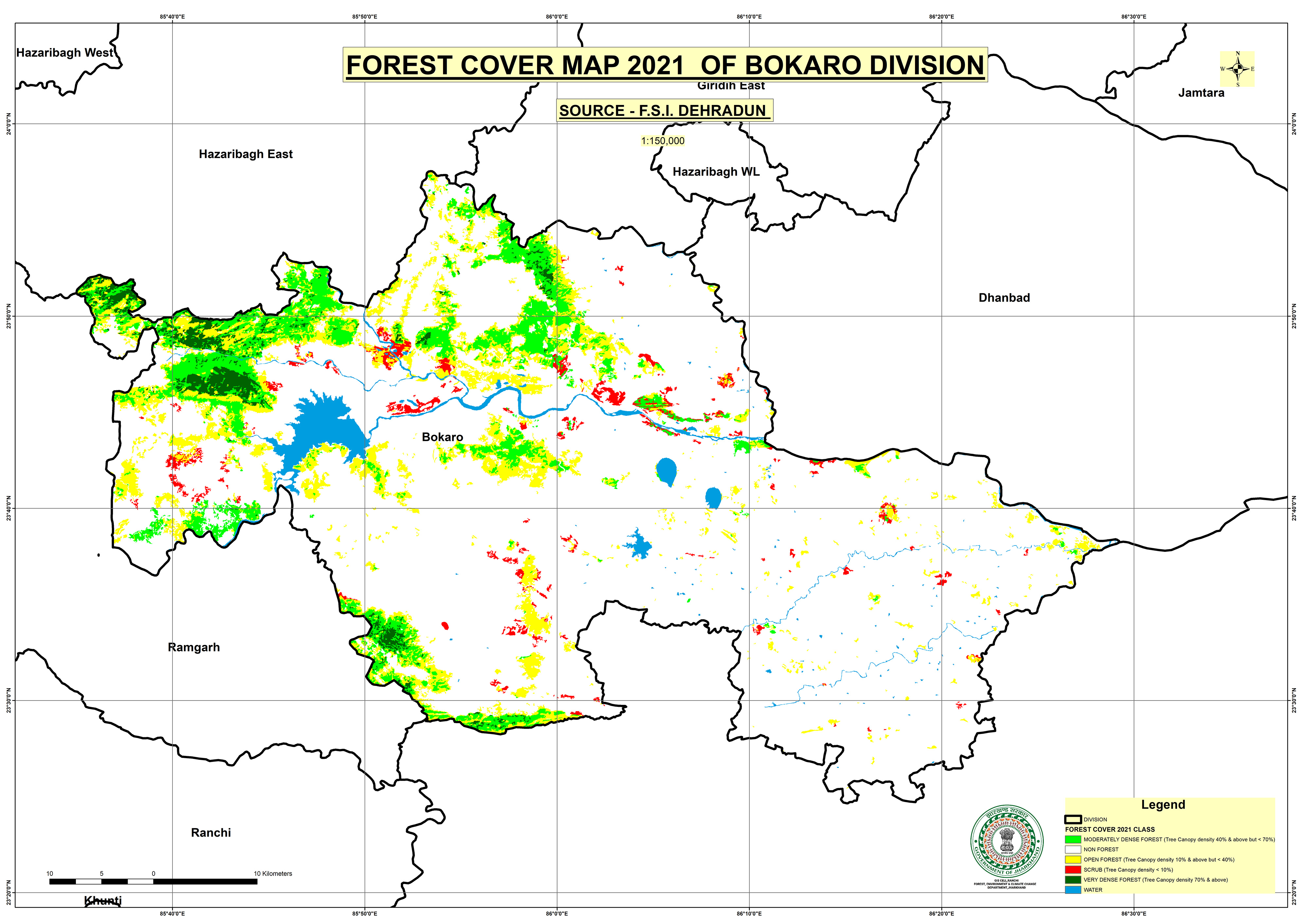
About Bokaro District
Bokaro district is located in the state of Jharkhand, India. It is known for its industrial significance, being home to the Bokaro Steel Plant, one of the largest steel manufacturing units in the country. The district encompasses a rich cultural heritage and diverse natural landscapes. Bokaro district was created in the year 1991 by carrying out one subdivision consisting of two blocks from Dhanbad District and six blocks from Giridih Distirict. The present Bokaro district is bounded by Giridih in the North, Purulia (West Bengal) in the south, Dhanbad in the east and Hazaribagh in the west.
Geography and Physical Features
The topography is hilly with occasional tracts of flat plateau and valleys. The terrain is extremely varied and is spotted with several prominent hills. The district is a part of the Chhotanagpur Plateau and may be categorized into three natural formation:-
- Central plateau.
- Lower plateau.
- Damoar, Garga&Tenughat Valley.
Damodar, Bokaro, Konar and Barakar are the main rivers traversing the territory. Barakar is a small river which flows into the Konar, a tributary of Damodar river.
The area has typical three distinct seasons, the summer, the rainy and the winter seasons of the monsoon type of climate. Hot weather is experienced all over the track during the months of mid April to June when the maximum temperature touches to 44-46 degree Celsius on few days. Pre-monsoon showers during late May or early June are common features. The winter is generally pleasant except for few days when the night temperature almost touches the freezing point.

Sanjay Srivastava,- IFS
Principal Chief Conservator of Forests & Head of Forest Force
Ranchi, Jharkhand
About Bokaro Forest Area -
Bokaro Forest Division which came into being in the year 1997 from the areas taken out from Dhanbad, Giridih and Hazaribagh East Forest Divisions. It comprises of six ranges namely Petarbar, Gomia, Tenughat, Bermo, Bokaro and Chas.
Forests of this division are spread over the eastern part of the Hazaribagh plateau and lie mainly on its undulating slopes. The topography is hilly with occasional tracts of flat plateau and valleys. : The forest area of Bokaro comprises a mix of vegetation types, including tropical dry deciduous forests, mixed forests, and scrub forests. The dominant tree species include Sal (Shorearobusta), Mahua (Madhucalongifolia), Tendu (Diospyros melanoxylon), Palash (Butea monosperma), and Bamboo (Bambusoideae). These species form the upper canopy and provide shade and habitat for a variety of plants and animals.